_edited_edited.png)
What Is Retained Search and How Does It Secure Top Talent
- Janis Kolomenskis
- 1 day ago
- 13 min read

Picture this: you need a world-class heart surgeon for a life-or-death operation. You wouldn't just post a job ad on LinkedIn and hope for the best, would you? Of course not. You'd find a specialist—a headhunter—to meticulously track down the absolute best person on the planet for the job.
That, in a nutshell, is retained search. It's an exclusive, committed partnership with a recruitment firm, designed specifically to fill those game-changing leadership roles where leaving the seat empty costs you a fortune in lost opportunity.
Your Executive Hiring Playbook Starts Here

When the future of your company rests on finding the right leader, your typical hiring process just won’t cut it. This is where you graduate from transactional recruiting to making a strategic investment. Retained search is the go-to playbook for savvy companies looking to land leaders who don't just fill a role—they define it.
This model is a whole different beast compared to other ways of hiring. It's built on a foundation of deep partnership and exclusivity. Your company pays a search firm an upfront fee—a retainer—to lock in their dedicated time and resources for a deep, exhaustive hunt.
We're not talking about sorting through résumés from active job seekers. This is about proactively mapping the market to identify, engage, and persuade the true A-players—the top performers who are already killing it in their current jobs and aren't even looking.
A Partnership Built on Commitment
The way it's paid for is what really sets retained search apart. Think of it as a premium, white-glove service. Clients typically pay a fee between 25-33% of the candidate's first-year compensation, often in installments. This upfront financial commitment guarantees the search firm is all-in on your role, and only your role.
This "skin in the game" approach delivers some serious advantages:
True Collaboration: The search firm essentially becomes an extension of your team. They dive deep to understand your culture, your strategic goals, and the subtle, unwritten requirements of the role.
Access to the "Hidden" Talent Pool: Retained recruiters are masters at market intelligence. They find the stars who aren't on job boards and would never apply for a job themselves.
Iron-Clad Confidentiality: Need to replace a current executive or create a new role under the radar? The retained model is built for discretion from the ground up.
This dedicated partnership is the secret sauce. It completely changes the dynamic from a frantic race to fill a job to a strategic mission to find the one perfect leader to shape your company's future.
Of course, knowing what retained search is is just the start. To really sharpen your hiring edge, check out these excellent recruiter tips for hiring top talent for a broader perspective.
Retained Search vs. Contingency Search: What's the Real Difference?
So, you need to hire someone. You've heard these terms thrown around—retained search, contingency search—but what do they actually mean for you? Let's cut through the jargon.
Imagine you're building your dream house. Retained search is like hiring an architect and a dedicated general contractor. You pay them for their expertise and their process, and they're 100% committed to your project from blueprint to final walkthrough. They're your partner.
Contingency search, on the other hand, is more like telling a dozen real estate agents you're casually looking. They’ll show you whatever is on the market, but they only get a commission if you happen to buy a house they showed you. They're playing the odds.
This single difference—a committed partnership versus a transactional race—changes everything about the hiring experience.
Commitment and Exclusivity
This is the absolute heart of the matter. With retained search, you're paying for a firm's dedicated time and deep expertise. This isn't just a service; it's an exclusive, high-trust partnership. The search firm becomes a true extension of your team, acting as a strategic advisor who is completely invested in getting this hire right. Their reputation is on the line with every search.
Contingency recruiting operates on a "no win, no fee" model. While that sounds great on the surface, it means recruiters are constantly juggling dozens of roles from different companies. Their focus is spread incredibly thin. Naturally, they're going to put their energy into the roles they think they can fill the fastest—which might not be yours.
A retained firm is a strategic partner invested in your long-term success. A contingency firm is a vendor focused on closing a short-term transaction.
Candidate Quality and Sourcing
The level of commitment directly shapes the talent pool you get to see. Retained search firms are masters of deep market mapping and genuine headhunting. They don't just post an ad and hope for the best.
They proactively identify, engage, and court the best possible candidates for your specific role. This includes the elusive top-tier passive talent—those A-players who are crushing it in their current jobs and aren't even thinking about looking. You won't find them on a job board.
Contingency recruiters, because they’re in a high-speed race against other firms (and often your own internal team), primarily rely on active candidates. They fish in the same ponds: their existing database and job board applicants. Speed trumps depth. The goal is to get a resume in front of you fast, which means the hidden gems, the game-changing leaders, are often left undiscovered.
Fee Structure and Motivation
Money talks, and in recruiting, it creates wildly different motivations.
Retained Search: The fee, typically 25-33% of the candidate’s first-year total compensation, is usually paid in three parts. You pay a third to kick off the search, a third when they present a shortlist of vetted candidates, and the final third when the hire is made. This structure aligns everyone's goals toward a thorough, high-quality process from start to finish.
Contingency Search: The entire fee, usually 20-30% of the first-year base salary, is only paid if you hire their candidate. This model incentivizes one thing above all: speed. The recruiter's primary goal is to be the first person to submit a resume that sticks. It’s a numbers game that can sometimes prioritize quantity over true quality.
Here's a quick cheat sheet to see how these two models stack up side-by-side.
Retained Search vs. Contingency Search at a Glance
This table breaks down the core differences, helping you see which model aligns with your hiring needs.
Feature | Retained Search | Contingency Search |
|---|---|---|
Relationship | Strategic Partnership | Transactional |
Exclusivity | Exclusive, dedicated to one client's search | Non-exclusive, works with many clients at once |
Payment Model | Retainer-based (paid in installments) | Success-based (paid only on successful hire) |
Ideal For | C-suite, VP, Director & niche, critical roles | Junior-to-mid level & high-volume roles |
Sourcing Focus | Passive candidates, headhunting, market mapping | Active candidates from databases & job boards |
Motivation | Quality of hire & process thoroughness | Speed to placement |
Commitment | High commitment from both client and firm | Low initial commitment; recruiter may drop search |
Timeline | More structured and predictable (4-12 weeks) | Highly variable, can be very fast or never end |
Ultimately, your choice boils down to the strategic importance of the role.
If you're hiring a mission-critical leader who will define your company's future, the dedicated, in-depth partnership of retained search is a powerful strategic investment. But for less senior, easier-to-fill roles where speed is key, the lower upfront risk of contingency can be a perfectly sensible option.
The Retained Search Journey Step by Step
So, what does a retained search actually look like in practice? Forget just posting a job ad and hoping for the best. This is a meticulously crafted journey, a true partnership designed to land that perfect leader who will shape your company's future. It turns the often-murky world of executive recruiting into a transparent, collaborative mission.
Let's pull back the curtain and walk through the typical stages of this high-stakes process. This isn't a mad dash for résumés; it’s a marathon of precision built on deep collaboration and clear milestones, making sure everyone is on the same page from kickoff to onboarding.
Phase 1: The Deep Dive and Strategy Session
It all kicks off with a profound discovery phase. Think of your search partner as a business consultant who embeds themselves in your world. They spend serious time getting under the hood to understand not just the role, but your company's very DNA. They need to know your culture, your big-picture strategic goals, the competitive battlefield you're on, and all those unspoken qualities that make a leader thrive in your unique environment.
This initial immersion leads to a detailed position specification and a robust search strategy. This isn't your average job description. It’s a strategic blueprint outlining the ideal candidate profile, critical competencies, and a clear roadmap for the entire search.
Phase 2: Market Mapping and Candidate Identification
With the strategy locked in, the real headhunting begins. This is where your search firm flexes its muscles, meticulously mapping the market to pinpoint exactly where your ideal candidates are currently working and succeeding. The magic of retained search really shines here, as recruiters go after those high-performing executives who aren't even looking for a new job.
A massive part of the retained journey involves expert techniques for how to source candidates who are off-market and hard to reach. The outreach is discreet, professional, and compelling—it has to be, to grab the attention of an already successful leader.
The flowchart below breaks down the fundamental differences between the retained and contingency models.
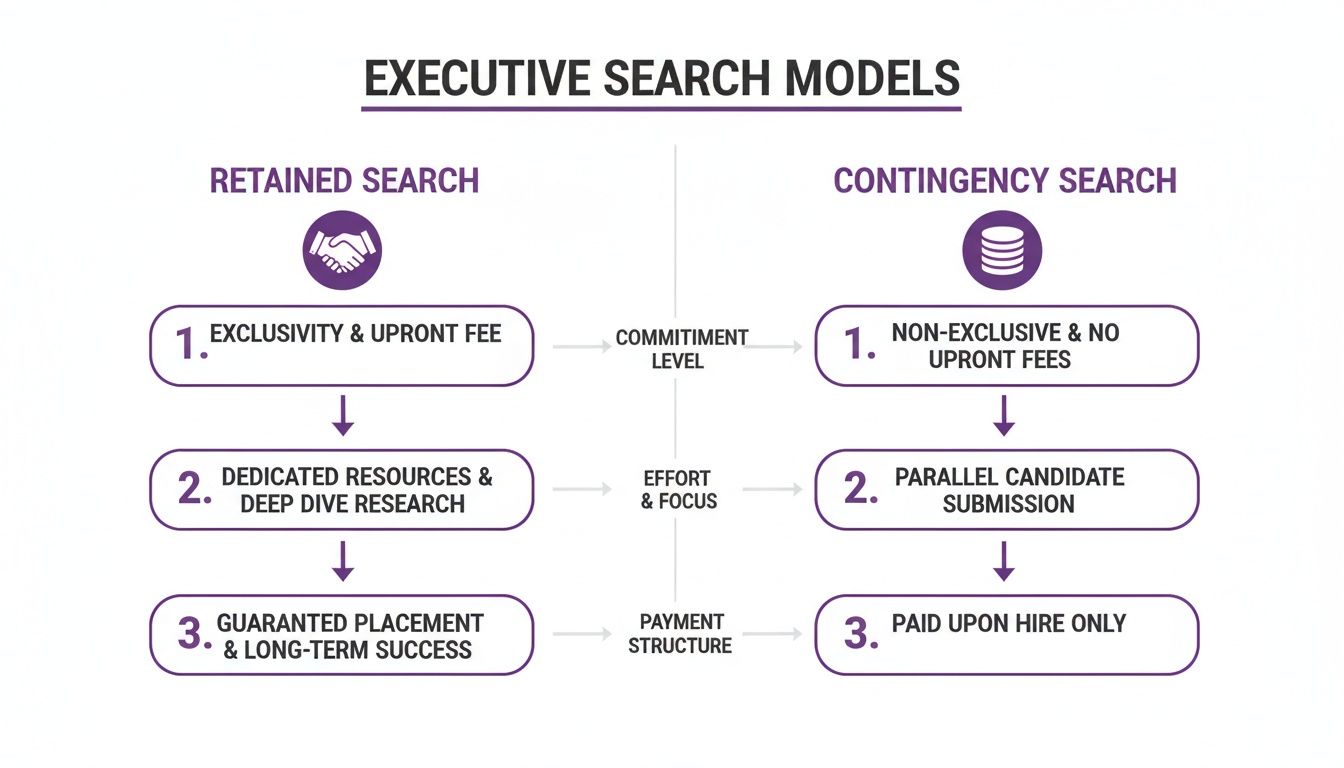
You can see how the committed, partnership-driven nature of a retained search is a world away from the transactional, numbers-game approach of contingency recruiting.
Phase 3: Rigorous Vetting and Shortlist Presentation
Once potential candidates are identified and engaged, they enter a tough, multi-stage assessment. We’re talking way beyond a quick résumé scan. This involves in-depth interviews, competency evaluations, and even preliminary reference checks to thoroughly vet their skills, leadership style, and cultural alignment.
The goal isn’t to build a long list of possibilities; it’s to deliver a shortlist of exceptionalities. A retained firm’s reputation is on the line, so they will only present the most qualified, deeply vetted candidates who are a true strategic match.
The firm then presents this curated shortlist to you, armed with detailed reports on each person. These profiles give you a 360-degree view of their strengths, potential, and what truly motivates them in their career.
Phase 4: Offer Negotiation and Post-Placement Support
You’ve interviewed the shortlist and found your person. Awesome! Now, the search firm shifts gears, becoming your trusted mediator. They expertly manage the entire offer stage, navigating tricky compensation negotiations, defusing counteroffers, and ensuring you get a smooth, enthusiastic acceptance.
But the work doesn't stop when the contract is signed. The best retained firms provide extensive post-placement support for both you and your new hire. This follow-up is crucial. It ensures a seamless transition and sets the stage for long-term success, cementing the placement and delivering on the promise of a lasting leadership solution.
Why Top Companies Choose Retained Search

Let's be clear: retained search isn't just another way to farm out hiring. It’s a strategic move, a power play to gain a serious competitive advantage. When a role is so vital that leaving it empty means losing ground to your rivals, you can't afford a "post and pray" approach. This is when the smartest companies go all-in to land leaders who don't just fill a seat—they redefine the game.
The real magic here is all about access. A retained partnership throws open the doors to the true A-players, the passive candidates who are absolutely crushing it in their current roles. These aren't people scrolling through job boards. They're the top performers who are completely off-the-grid to typical recruiters, but they will absolutely take a call from a specialist headhunter they know and trust.
Gaining Exclusive Access and Market Intelligence
The beauty of an exclusive partnership is that the search firm is 100% committed to your success. They aren't just another vendor; they become an extension of your brand, hitting the market with a compelling story to turn the heads of the very best talent. This focused, dedicated hunt means you get to see candidates your competitors don't even know exist.
But wait, there's more. The process itself is a goldmine of market intelligence. As your search partner maps out the entire talent landscape for your role, you're getting a real-time feed of insights on your competitors' organizational charts, salary benchmarks, and emerging industry trends. This isn't just hiring; it's a consultative deep-dive that makes you a smarter, more competitive employer.
Retained search isn't just a hiring process; it's a strategic intelligence mission. You're not only finding a person—you're gaining a deep understanding of your talent market that pays dividends long after the role is filled.
Ensuring Confidentiality and Mitigating Risk
Confidentiality is a huge win here. Maybe you're quietly replacing an executive who isn't cutting it, or perhaps you're building a new division and don't want to tip off the competition. A retained search provides a bulletproof shield of discretion. The firm manages all the delicate conversations, keeping your strategic plans under lock and key.
It’s also a powerful way to manage risk. The cost of a bad senior hire is astronomical. With 46% of new hires failing within 18 months, getting it right the first time is non-negotiable. A thorough retained process, which almost always includes a meticulous onboarding plan, can boost new hire retention by an incredible 82%, directly impacting your bottom line. You can explore more key recruitment statistics and their implications to see just how critical this is.
At the end of the day, companies invest in a retained search for one simple reason: it delivers. The dedicated focus, deep market penetration, and iron-clad vetting process result in much higher placement success rates and employees who stick around for the long haul. It's about finding a leader who not only performs but stays to drive your company's growth for years to come.
Navigating Costs and Timelines in Retained Search
When you're bringing on a game-changing leader, you need to know what you’re getting into—both financially and in terms of time. A retained search isn't about filling a seat quickly; it's a strategic mission with a clear roadmap for cost and calendar. The goal here is maximum impact, not just speed.
Think of it this way: contingency search is a "no win, no fee" sprint. Retained search, on the other hand, is a true partnership. Your fee is an investment in a dedicated, high-touch process, paid in stages to keep everyone aligned on key milestones. This structure is what guarantees the search firm is all-in from the moment you say "go."
The Standard Payment Structure
So, how does the money part actually work? The most common model is beautifully simple: the total fee is split into three equal payments. This gives you predictable cash flow and secures the firm's undivided attention for your search.
Here's the usual breakdown:
First Installment: This is the "retainer" you pay upfront to kick everything off. It secures the firm’s exclusive commitment and gives them the resources to dive deep into market mapping and building out the search strategy.
Second Installment: This payment typically comes 30-60 days later. It usually lines up with a major milestone, like the presentation of the first shortlist of incredibly well-vetted candidates. This is your proof that the search is on track and top talent is in play.
Final Installment: The final piece of the puzzle is paid once your chosen candidate accepts the offer. Mission accomplished.
This phased approach really cements the partnership. You aren't just paying for a final result; you're investing in a meticulous, white-glove process every step of the way.
Understanding the Timeline
Patience is a virtue in retained search. This is a marathon, not a sprint. While every search has its own unique rhythm, you should realistically plan for a timeline of 90 to 120 days from the initial briefing to the candidate signing on the dotted line. Trying to rush it only puts the quality of your hire at risk.
In retained search, the investment is not just a fee; it's a commitment to a rigorous, proven process designed to secure leadership capital that will drive your company's future success.
This timeline reflects all the painstaking work happening behind the scenes. It's why this model dominates searches for senior roles with salaries north of $150,000.
But don't let that timeline scare you! Modern tools are making a massive difference. According to some eye-opening hiring trends and statistics, an impressive 59% of placements are now wrapped up in under 20 days. And with AI-powered workflows entering the picture, firms are seeing 75% faster hires.
At the end of the day, the investment in time and money pays for itself. You get a transformational leader who is perfectly aligned with your company's vision and ready to hit the ground running.
Your Top Retained Search Questions, Answered
Alright, so you get the basics of retained search. But let's be honest, it's a big commitment—a serious strategic investment. It’s completely normal to have a few lingering questions before you dive in. You need to be 100% confident this is the right move for your company's next game-changing hire.
Let's cut through the noise and tackle the questions I hear most often. Think of this as your personal FAQ, designed to clear up any doubts and give you that final bit of clarity you need. We'll cover everything from when to pull the trigger to what happens if things don't go as planned.
When Is the Right Time to Use a Retained Search Firm?
The simplest answer? You go retained when a bad hire would be an absolute disaster for your business. This model is your go-to weapon for those senior-level, strategically critical roles—think C-suite executives, VPs, or specialized directors who can make or break a company.
It's time to call in a retained firm when:
You need to keep things quiet. Maybe you're replacing a current executive or building a new division on the down-low. Confidentiality is paramount.
The role is a unicorn hunt. The position demands a seriously rare mix of skills, niche experience, and deep industry know-how.
"Good enough" won't cut it. Your goal isn't just to fill a seat; it's to land the absolute best person for the job—the A-players who aren't looking at job boards because they're too busy excelling.
Ultimately, it’s not just about the job title. It's about how much that specific role will shape your company's future.
What Happens if a Retained Search Fails to Find a Candidate?
This is a big one, and it's a fair question. But this is exactly where the beauty of the retained partnership model comes into play. A reputable firm isn’t just a vendor; they are contractually obligated to see the search through to the very end. Their entire reputation is on the line.
If the first round of candidates doesn't yield the perfect hire, the firm doesn't just walk away. They are on the hook to restart and recalibrate the search until the role is filled, usually at no extra cost. Plus, almost every retained search agreement comes with a guarantee period.
This is your safety net. It means that if your new executive leaves the company for any reason within a set period (typically 12 months), the search firm will find you a replacement by conducting an entirely new search, completely free of charge. It's a powerful way to protect your investment.
How Do I Choose the Right Retained Search Partner?
Picking the right firm is just as critical as the search itself. You aren't just looking for a recruiter; you're looking for a strategic advisor. The best partners bring deep market intelligence to the table and aren't afraid to challenge your thinking to make the search even better.
Look for a firm that has a proven track record in your specific industry. Ask for case studies and don't hesitate to speak with their references for similar roles they've placed. Most importantly, make sure you click with the actual team running your search, not just the person who sold you the contract. A true partner invests the time to really get your company culture and where you're headed.
Here at Yena, we know that the right technology can be a game-changer in a high-stakes search. Our AI-native platform is built specifically for executive search firms, weaving powerful AI directly into their core process. The result? Unbelievable accuracy and hours saved every single week. Find out how to put your executive search into overdrive at https://yena.ai.
Comments