_edited_edited.png)
Reduce Time to Hire: Win Top Talent Fast (reduce time to hire)
- Janis Kolomenskis
- 4 days ago
- 14 min read

If you want to reduce time to hire, you have to stop playing defense. The old way of waiting for a role to open up and then scrambling to fill it is a recipe for disaster. It’s time to get ahead of the game by building a continuous talent pipeline and fine-tuning every single step of your process before you even have a vacancy. This isn't just about filling roles faster; it's about turning a costly, stressful fire drill into a massive competitive edge.
Why a Slow Hiring Process Is a Silent Killer
Let’s be honest, a sluggish hiring process is more than just a minor annoyance. It's a silent killer that methodically drains your company's momentum and eats away at your reputation. We're in a market where the best candidates are gone in just 10 days. Every single day you waste is another day your competitors get closer to hiring your next superstar.
This isn't just about losing one person. It's about the cumulative damage a slow, clunky process does to your entire business.

Globally, the average time to hire has stretched to a painful 68.5 days—a huge leap from just a couple of years ago. This drawn-out timeline is creating a genuine crisis, with 76% of employers already admitting they can't find quality candidates. Now, imagine trying to keep those rare gems engaged through a two-month-long process. It’s nearly impossible.
The Ripple Effect of Vacant Roles
When a key position sits empty for weeks on end, the pain isn't confined to the recruiting team. Your current employees are stuck picking up the slack. They get overworked and burned out, productivity nosedives, and morale plummets.
Suddenly, critical projects are stalled, deadlines are blown, and innovation just stops. That empty desk becomes a glaring symbol that the team is stretched thin, often sparking a domino effect where your other great employees start looking for the exit.
This is why getting a handle on the true cost of a vacancy is so important. If you're looking for ways to get ahead, check out these proven strategies to reduce time to hire without sacrificing quality.
The costs of a delayed hire are often much larger than they appear on the surface. They show up in lost productivity, team burnout, and missed business opportunities. It’s a financial drain that goes far beyond just a recruiting budget.
The Hidden Costs of a Delayed Hire
Impact Area | Direct & Indirect Costs |
|---|---|
Productivity Loss | The vacant role's output is zero, and the team covering the work operates at reduced efficiency. |
Team Morale & Burnout | Existing employees become overworked and disengaged, leading to higher turnover rates and associated costs. |
Recruitment Costs | The longer a role is open, the more you spend on job board fees, advertising, and recruiter time. |
Lost Revenue | Sales roles can't sell, developers can't build, and customer service gaps lead to churn. |
Opportunity Cost | Key projects are delayed, and innovation slows, allowing competitors to gain a market advantage. |
Employer Brand Damage | A slow process creates a poor candidate experience, tarnishing your reputation and making future hiring harder. |
As you can see, letting a role stay open for too long creates a cascade of negative effects that can hamstring your entire organization. It's not just a "hiring problem"—it's a business problem.
Your Employer Brand Is on the Line
Candidates talk. They share their experiences on Glassdoor, LinkedIn, and with their friends. A disorganized, slow, and unresponsive hiring experience screams that your company is bureaucratic, indecisive, and frankly, doesn't respect people's time.
That negative impression doesn't just lose you the candidate you're interviewing. It poisons the well for future hires, making it exponentially harder to attract top talent down the road.
A slow hiring process is the loudest, most convincing argument a top candidate will hear for accepting a competitor's offer. Speed isn't just a metric; it's a signal of a dynamic, decisive, and respectful organization.
At the end of the day, your time-to-hire is more than just a number on an HR report. For a deeper look at the data you should be tracking, check out our guide on the essential recruiting metrics to improve hiring in 2025. It's a direct reflection of your company's agility and its ability to win the talent that will define its future.
Build Your Talent Pipeline Before You Need It
Let’s be honest, the biggest mistake any of us can make in recruiting is starting from scratch every single time a role opens up. That mad dash to post a job and pray is a surefire way to lose weeks, watch top candidates go elsewhere, and frankly, frustrate your hiring managers.
To really get ahead and slash that time-to-hire, we have to flip the script from reactive filling to proactive building.

Picture this: your star Senior Developer hands in their notice. Instead of panicking, you pull up a list of five high-potential, pre-vetted candidates who already know your brand and are genuinely interested in what you’re doing. That’s the magic of a healthy talent pipeline. It turns a potential crisis into a smooth, strategic move.
This isn't about hoarding resumes in a folder somewhere. It's about cultivating a real community of professionals who see you as a top-tier employer long before they ever start job hunting. You're building a bench of incredible talent that's ready and willing to engage.
Engage Talent Where They Actually Hang Out
The best people aren't refreshing job boards all day. They’re busy learning, networking, and sharing ideas in their own professional circles. Your mission is to meet them on their turf, not as a recruiter with an open req, but as a genuine contributor to their community.
Niche Online Communities: Dive into relevant Slack channels, Discord servers, or specialized forums. If you're hiring for tech, find a user group for a specific programming language. For a marketing role, jump into a community dedicated to SEO or growth hacking.
Industry Events (Virtual & In-Person): Don't just be a wallflower—get involved! Ask smart questions during Q&A sessions, chat with people in breakout rooms, and make a point to connect with speakers afterward.
Smart Social Media Engagement: Follow industry leaders and rising stars. But don't just "like" their content. Leave thoughtful comments that add real value to the conversation.
This kind of consistent, authentic engagement builds incredible trust and keeps your company on their radar. When you finally do have a role to fill, your outreach won't feel cold and spammy; it'll feel like a natural next step in a relationship you've already started.
Nurture Your Pipeline by Adding Value
So, you've identified some amazing passive candidates. What now? The key is to keep them warm without being annoying. This is where strategic nurturing makes all the difference. A generic "just checking in" email is destined for the trash folder. Sharing something genuinely useful, on the other hand, is memorable.
A talent pipeline isn't a database; it's a relationship garden. You can't just plant seeds and walk away. You have to nurture connections with consistent value and authentic engagement until they're ready to bloom.
Put together a simple nurturing plan. It could be a quarterly email sharing your company’s latest tech blog, an invitation to an exclusive webinar you're hosting, or a quick, personalized note congratulating them on a work anniversary you spotted on LinkedIn. For a much deeper look, our guide on how to define a talent pool to supercharge your hiring is packed with more great strategies.
Adopting this mindset completely changes the game. Instead of starting from square one and burning weeks just on sourcing, you’re activating a pre-warmed network of high-quality people who are already interested. This is one of the single most powerful ways to dramatically reduce time to hire and stay one step ahead of your company's talent needs.
Turn Your Team Into a Recruiting Powerhouse
Let's be honest, who knows your company culture and the perfect person for that open role better than your own team? Your current employees are your most powerful, authentic, and often completely untapped recruiting asset. Building a killer employee referral program isn't just about throwing cash at people; it's about creating a culture where everyone is fired up to be a talent scout.
When you get your team to refer people from their network, you're tapping into a goldmine of pre-vetted talent. These aren't just random names from a job board; they are professionals whose skills and work ethic are already vouched for by someone you trust. Trust me, making this simple shift can seriously slash your time-to-hire.
Make Referring Ridiculously Easy
The number one reason referral programs fail? Friction. If an employee has to navigate a clunky intranet, fill out a form from the stone age, or hunt down someone in HR for an update, they're just not going to do it. Your program has to be visible, simple, and crystal clear.
One-Click Submissions: Give them a dedicated, impossible-to-miss portal or even a super simple form where they can drop in a name and a LinkedIn profile in less than 60 seconds.
Constant Visibility: Be relentless in promoting the program. Shout it out in all-hands meetings, drop reminders in your company-wide Slack or Teams channels, and make a big deal out of successful referrals publicly.
Automated Updates: Keep your referrers in the loop! A simple automated email that says, "Hey, we've contacted your referral!" or "We just interviewed Sarah!" makes them feel valued and part of the process.
This approach flips referring from a tedious chore into something quick and engaging. The less work you make it for them, the more fantastic candidates you'll see pouring into your pipeline.
Go Beyond Just a Cash Bonus
Look, a financial incentive is great, but it's rarely the only thing that gets people moving. The best referral programs I've seen mix tangible rewards with genuine recognition and experiences that celebrate the company culture. You want to offer rewards that create buzz and get people talking.
Referral hires offer a proven shortcut to reduce time to hire, getting onboarded 55% faster than candidates from job boards or agencies. In today's talent crunch, where the global average time to fill sits at 44 days, employee networks deliver pre-vetted talent who are 76% more likely to accept offers. Discover more about the impact of referral programs on joingenius.com.
To really light a fire under your team, think about a tiered incentive structure. For example, an employee could get a small bonus for a successful first interview, a much bigger one when their referral is hired, and then get an entry into a quarterly grand prize drawing for something truly memorable—like an incredible vacation or extra paid time off.
This kind of structure celebrates effort at every step, not just the final hire. When you turn your entire workforce into an active and excited recruiting engine, you build a powerful, sustainable advantage that consistently brings in top-tier talent faster than any other source.
Design an Interview Process Candidates Love
The interview stage is where all your hard-won momentum can either accelerate into a signed offer or grind to a screeching halt. Let's be real: a clunky, disorganized, and drawn-out interview process is the fastest way to lose a fantastic candidate. It screams that your company is indecisive and doesn't respect their time, which is a massive red flag for anyone you’d actually want to hire.
Let’s build a playbook for a sleek workflow that not only impresses candidates but also helps you seriously reduce time to hire. We want to create an experience that shows your company is the organized, decisive, and exciting place it is.
Combine and Conquer Your Interview Stages
It’s time to stop thinking in terms of rigid, sequential steps. The old model—a phone screen, then a hiring manager call, then a technical round, then a team interview, then a final executive chat spread over three weeks—is a relic. Your competitors are moving way faster.
Instead, think about combining stages. Could the initial screen and the hiring manager call be one efficient, focused conversation? Can the technical assessment and the team-fit interview happen back-to-back in a single "interview block"?
This simple shift shows tremendous respect for everyone's calendar.
Group Related Interviews: Try scheduling the technical deep-dive and the team interviews on the same day.
Empower Your Panel: Give your interviewers the autonomy to make decisions without needing six more rounds of validation.
Set Clear Timelines: Be transparent and communicate the entire process upfront. Candidates are much happier when they know exactly what to expect and when.
This isn't about rushing; it's about being ruthlessly efficient. Condensing the timeline creates a sense of urgency and excitement, keeping top candidates engaged when they might otherwise drift away.
The moment a candidate enters your interview process, the clock is ticking against their enthusiasm. A streamlined, respectful, and decisive process doesn't just fill roles faster—it becomes a core part of your employer brand.
Use Structured Questions and Scorecards
Let’s face it, subjective "gut feelings" are slow, biased, and notoriously unreliable. If you want to make confident decisions quickly, you need a structured approach.
Before you even start, develop a core set of role-specific questions that every single candidate answers. Pair this with a simple scorecard for interviewers to rate their responses. This method ensures you're evaluating everyone on the same fair criteria, which dramatically cuts down on those endless post-interview debates.
When the hiring manager can look at clear, comparable data points instead of vague impressions, the decision becomes much easier and faster.
For more hands-on tips, check out our guide on acing the interview experience for top talent.
Prepare and Extend the Offer Instantly
This is it. The final stage is where delays are most fatal. Once your team has made a decision, the offer needs to go out within hours, not days. Any hesitation gives your top candidate time to receive—and accept—an offer from a competitor.
Have your offer letter templates ready to go. Make sure all necessary approvals (like salary bands) are sorted out before the final interview even happens. When you find the right person, you should be able to extend a compelling, well-prepared offer almost immediately.
That kind of decisiveness is incredibly impressive to candidates and slams the door on your competition for good.
Let Smart Tech Do the Heavy Lifting So You Can Hire Faster
Let's be honest: manual recruiting is a soul-crushing time suck. How many hours have you lost sifting through mountains of resumes, trying to align five different calendars for one interview, or chasing candidates with follow-up emails? These are the exact tasks that bring your hiring process to a screeching halt. It’s time to hand off the grunt work to technology and get back to what you do best—connecting with incredible people.
The right recruiting tools aren't just a "nice-to-have" anymore; they're essential. They’re designed to automate the most draining parts of your job, turning weeks of painful admin into just a few hours of focused, high-impact work. By embracing smart tech, you're not just speeding things up—you're building a smarter, more strategic hiring engine.
Use an ATS as Your Central Command
If you want an efficient recruiting operation, a powerful Applicant Tracking System (ATS) is non-negotiable. Think of it as your brain, your command center for everything hiring. It’s the single place where every candidate profile, every conversation, and every piece of team feedback lives in perfect harmony. No more digging through email chains to find a resume or trying to remember who you talked to last Tuesday.
A great ATS is more than just a digital filing cabinet. It’s an active partner that helps you slash your time to hire by automating communication and pushing candidates forward. It can handle rejection emails, schedule follow-ups, and give you a crystal-clear snapshot of your entire pipeline. If you're looking to really get into the weeds, we've put together a comprehensive guide to Applicant Tracking Systems that's a perfect place to start.
This chart really puts it into perspective—look at how much of the typical hiring process is still bogged down by manual work.
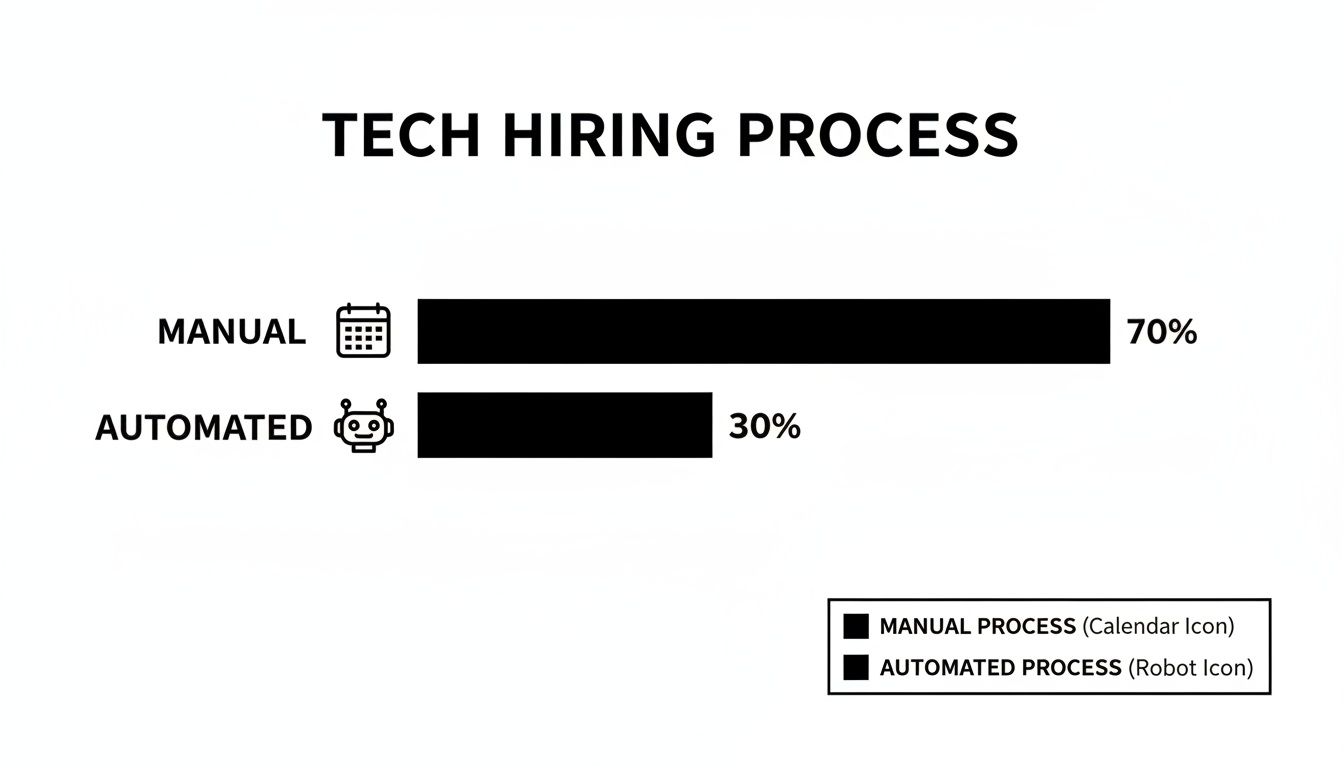
That 70% is a huge opportunity. It represents all the hours you can reclaim by letting technology take over the repetitive tasks, freeing you up for the strategic work that actually closes candidates.
The table below breaks down just how much of a game-changer this can be, comparing the old manual slog with a tech-accelerated workflow.
Hiring Technology's Impact on Your Timeline
Recruiting Task | Manual Approach (Average Time) | Tech-Accelerated Approach (Average Time) | Key Technology |
|---|---|---|---|
Initial Resume Screening | 4-6 hours per 100 applicants | 15-30 minutes | AI-Powered Screening |
Scheduling Interviews | 2-3 days of back-and-forth | 5-10 minutes | Automated Schedulers |
Candidate Communication | 1-2 hours per day | 30 minutes (automated) | Applicant Tracking System |
First-Round Screening | 5-10 hours (live calls) | 1-2 hours (asynchronous video) | One-Way Video Interviews |
See the difference? We're talking about saving entire days, not just minutes. This is how you build a process that top candidates will love and your competitors can't keep up with.
Screen Smarter, Not Harder, with AI
The initial resume review is almost always the biggest bottleneck in the entire process. I've been there—spending days on end reading through applications, eyes glazing over. It’s exhausting. But AI-powered screening tools can blast through that pile in minutes. And we're not talking about basic keyword searching. Modern AI digs deeper, analyzing actual skills and experience to find the people who are truly a great fit.
To get a better sense of what’s possible, this guide on the power of recruiting AI is a fantastic read. This technology lets you instantly surface the top 10% of your applicants. Imagine starting your day by talking to high-potential candidates instead of wading through a sea of unqualified ones.
By automating the top of your funnel, you’re doing more than just saving time—you’re completely changing the game. You get to engage the best people before your competition even knows they’re on the market.
Win Back Your Calendar with Video Interviews
Oh, the dreaded scheduling dance. Trying to coordinate a live interview can feel like a logistical nightmare, especially with different time zones and jam-packed calendars. It can easily take a full week just to lock down a 30-minute chat.
Video interviewing platforms give you and your candidates that time back. Here’s how:
One-Way Video Interviews: This is a game-changer. You send your screening questions, and candidates record short video answers on their own schedule. You can breeze through a dozen of these in the time it would take to do two or three live calls.
Live Video Calls: For later stages, having integrated video tools means you can schedule and host interviews right from your hiring platform. No more sending separate meeting links or dealing with technical glitches.
Using these tools gets rid of the scheduling friction and helps everyone connect more easily. This isn't about replacing the human touch; it’s about using technology to get to those meaningful, human conversations way faster.
Got Questions About Hiring Faster? We've Got Answers.
Let's be real: trying to speed up your hiring process can feel like you're walking a tightrope. You need to move fast to snag the best people, but you absolutely can't cut corners and make a bad hire. It’s a classic balancing act.
Here are the straight-up answers to the questions I hear most often from recruiters and hiring managers who are trying to shrink their time-to-hire.
So, What’s a Realistic Time-to-Hire Goal Anyway?
Everyone wants that magic number, but the best goal is actually much simpler: just be faster than the companies you're competing against for talent. For most professional roles, if you can get from application to a signed offer in 20-30 days, you’re in a fantastic spot.
But here’s a pro tip: start by measuring your own baseline. Your timeline for a software engineer is naturally going to look different than it is for a sales rep. Once you know your numbers, set a smart goal, like aiming to cut that time by 15% this quarter. Focusing on steady, continuous improvement beats chasing some generic industry average every single time.
A slow hiring process is almost always a sign of indecision. The secret isn't just about speed; it's about building a system that gives hiring managers the information and confidence they need to make a great call, fast.
How Can I Get My Hiring Managers to Move Quicker?
Ah, the million-dollar question. This is the bottleneck for so many of us, and the solution comes down to building a true partnership and setting expectations right from the kickoff. Before you even post the job, sit down with the hiring manager and hash out a clear Service Level Agreement (SLA).
This isn't about being bossy; it's about getting on the same page. Your agreement should spell out timelines for the big steps.
For instance:
Resume Review: We’ll both review all new applicants within 24 hours.
Interview Feedback: Feedback goes into the system within 24 hours post-interview. Period.
Proactive Scheduling: I'm going to pre-book interview slots on your calendar so we're ready to go.
The key is how you frame it. Don't make it a demand. Instead, say something like, "To land the kind of person we're looking for, we have to move as a team before our competitors can even get them on the phone." Suddenly, you've turned a potential roadblock into your biggest ally.
Is AI in Recruiting Going to Introduce Bias?
This is a huge and completely valid concern. Let's get one thing straight: a poorly built AI tool can absolutely bake in and even amplify human biases. But a good one? It can actually make your process less biased.
The best modern recruiting AI is intentionally designed to ignore demographic information—things like age, gender, or where someone went to school. It’s built to focus entirely on what actually matters: the skills, qualifications, and real experience shown on a resume.
When you're looking at any AI recruiting tool, you have to ask the tough questions. Dig into how their algorithms are trained, tested, and audited to fight bias. When you do your homework and choose wisely, AI can help you build a much more objective and fair screening process than most humans could ever achieve on their own.
Ready to turn your team's connections into your most powerful hiring tool? Yena maps every warm introduction path in your network, so you can reach top talent through trusted referrals, not cold outreach. See how Yena can slash your time-to-hire.
Comments